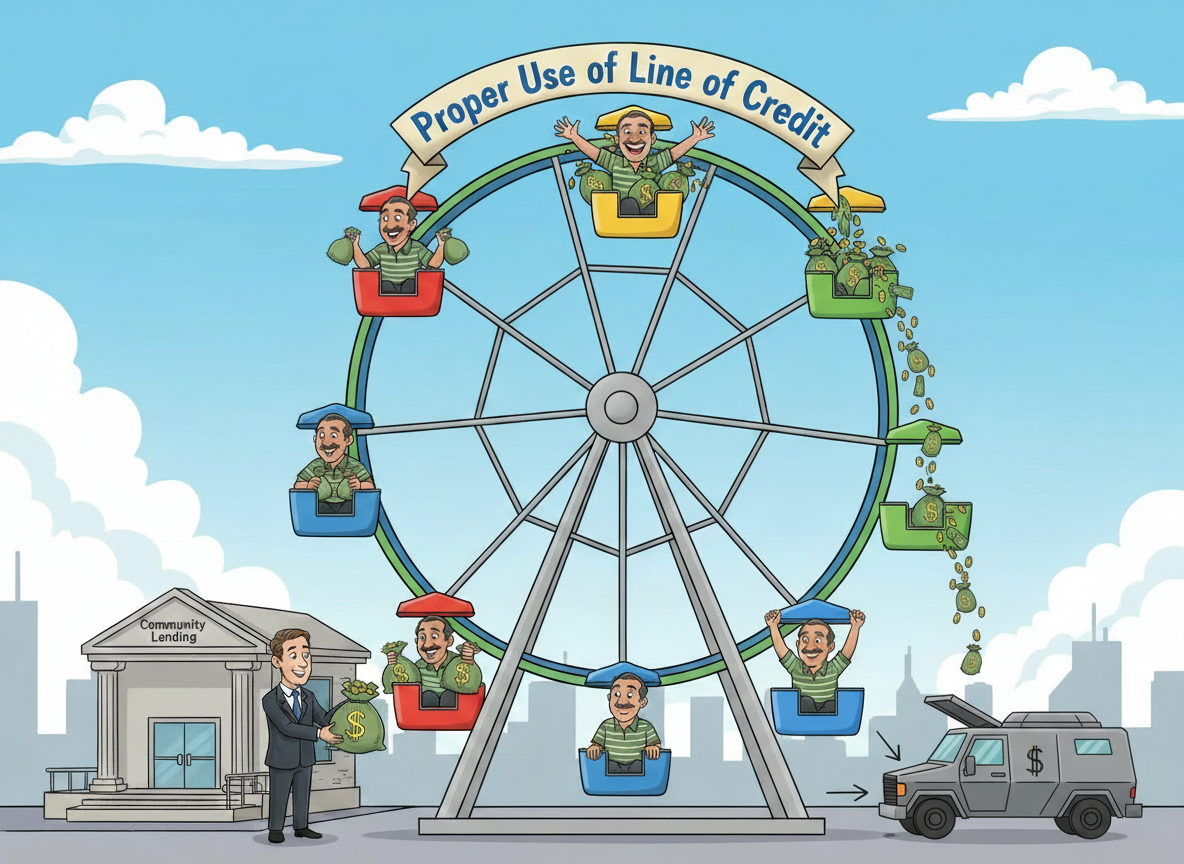
A commercial line of credit can be one of the most flexible financing tools available to a small business — but it’s also one of the most misunderstood. Unlike a traditional term loan that provides a lump sum upfront, a line of credit gives your business access to a pool of funds that you can draw from as needed, repay, and reuse again.
At its core, a commercial line of credit is designed to help businesses manage short-term cash flow gaps. Think of it as working capital support rather than long-term financing.
How a Commercial Line of Credit Works
A lender approves your business for a maximum credit limit — for example, $100,000. You can draw funds up to that limit when needed, and interest is typically charged only on the amount outstanding. As you repay the balance, the available credit replenishes.
Most commercial lines of credit are structured as:
- Revolving credit.
- Short-term commitments (often 1 or 2 years).
- Variable interest rates (WSJ Prime Rate plus X percentage points).
- Secured by business assets (such as accounts receivable or inventory).
Unlike term loans, lines of credit are intended for short-term cycles of borrowing and repayment.
How It Differs from a Personal Line of Credit (Like a HELOC)
A Home Equity Line of Credit (HELOC) is secured by your personal residence and is underwritten primarily based on your personal income, home equity, and credit score.
A commercial line of credit, by contrast:
- Is underwritten based on business cash flow and financial statements.
- Requires a personal guarantee.
- May be secured by accounts receivable, inventory, or other business assets.
- Is reviewed and renewed annually.
A HELOC is typically structured with a multi-year draw period (sometimes 10 years), while commercial lines of credit often require annual renewal and ongoing financial review.
“Clean-Up Periods” and Other Lender Expectations
One key difference between a commercial line of credit and a conventional term loan is the expectation of seasonal use.
Many banks and community lenders require what’s called a “clean-up period.” This means that at some point during the year — often 30 consecutive days — the line must be paid down to zero or near zero. The purpose is to demonstrate that the line is truly being used for short-term working capital needs, not as permanent debt.
Other common expectations include:
- Annual financial statement review.
- Shorter renewal terms (often 12 months).
- Borrowing base calculations tied to receivables or inventory.
- More active monitoring than a standard term loan.
In contrast, a term loan is usually approved once and repaid over time according to a fixed amortization schedule without annual renewal requirements.
When Does a Commercial Line of Credit Make Sense?
Commercial lines of credit are not appropriate for every business model. They are most effective in industries where working capital cycles fluctuate predictably.
Manufacturers often use lines of credit to purchase raw materials and pay labor costs upfront while waiting for payment on large contracts.
Building contractors frequently carry significant accounts receivable. A line of credit helps bridge the gap between paying subcontractors and collecting from customers.
Seasonal retailers, such as toy stores, garden centers, or specialty shops, may need to purchase large volumes of inventory months before peak sales season. If suppliers don’t offer extended “dating” terms that stretch beyond the holiday season, a line of credit can fill the gap.
In each case, the line is used to manage timing differences — not to fund long-term expansion or capital investments.
The Bottom Line
A commercial line of credit is a strategic cash flow management tool, not a long-term financing solution. When used properly — and in the right business context — it provides flexibility and stability. But it comes with more active oversight, shorter renewal terms, and expectations like clean-up periods.
For businesses with predictable cash flow cycles, it can be an invaluable resource. For others, a term loan may be the better fit. Understanding the difference is the first step in choosing wisely.