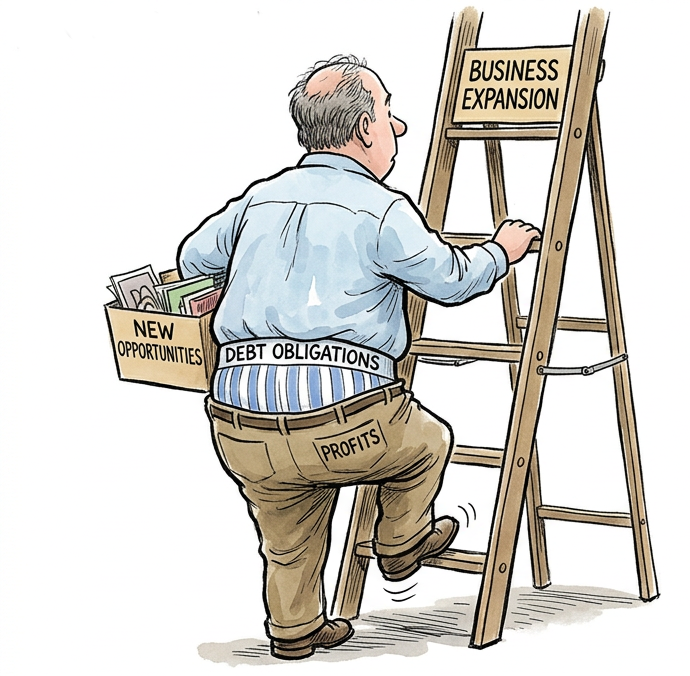
Is your lack of Debt Service Coverage showing?
A simple guide for small business owners
When you apply for a business loan, one of the most important things a lender looks at is your ability to repay it. At a community lender like a CDFI, this evaluation often comes down to a concept called Debt Service Coverage, sometimes referred to as the Debt Service Coverage Ratio (DSCR). While the term may sound technical, the idea behind it is actually quite simple.
What Is Debt Service Coverage?
Debt Service Coverage measures whether your business generates enough income to cover its debt payments. In other words, it answers a key question:
Does your business produce enough cash to pay all of its loans — including the new one you’re requesting?
The Basic Formula
The formula for Debt Service Coverage looks like this:
DSCR = Net Operating Income ÷ Total Debt Payments
Let’s break that down in plain language:
- Net Operating Income (NOI): This is the money your business earns after paying operating expenses (like rent, payroll, and utilities), but before paying debt.
- Total Debt Payments: This includes all required loan payments — both existing debts and the new loan you’re applying for.
A Simple Example
Imagine your business generates $100,000 in net operating income each year. Your total annual loan payments (existing + new loan) would be $80,000.
Your DSCR would be:
$100,000 ÷ $80,000 = 1.25
This means your business earns 1.25 times what it needs to cover its debt.
What Does the Number Mean?
- 1.0 = You are just breaking even (every dollar goes to debt — risky)
- Above 1.0 = You have extra cash (good)
- Below 1.0 = You don’t generate enough to cover your debts (problem)
Most lenders look for a DSCR of 1.20 to 1.30 or higher. This cushion shows that even if your revenue dips, you still have a margin of safety.
What Is Global Debt Coverage?
For small business owners, lenders often go one step further and look at Global Debt Service Coverage.
This means they consider:
- Your business income
- Your personal income
- Your business debts
- Your personal debts (like mortgages, car loans, credit cards)
The formula is similar:
Global DSCR = Total Combined Income ÷ Total Combined Debt Payments
Why does this matter?
Because for many small businesses, the owner and the business are financially connected. If your business struggles, you may rely on personal income to make payments — and vice versa.
Why Lenders Care About These Ratios
Debt service coverage is one of the clearest indicators of risk. For a lender, it answers:
- Can this borrower realistically repay the loan?
- Do they have a cushion if things don’t go as planned?
- Are they already stretched too thin financially?
CDFIs, in particular, are often more flexible than traditional banks. They may work with borrowers who don’t meet strict credit or collateral requirements. But they still need confidence that the loan is sustainable — not just for the lender, but for the borrower’s long-term success.
The Bottom Line
Debt Service Coverage isn’t just a number — it’s a snapshot of your financial health. By understanding and improving your DSCR, you show lenders that your business is stable, prepared, and ready to grow responsibly.
If you can demonstrate that you generate enough income to comfortably cover your obligations — both business and personal — you greatly improve your chances of securing the financing you need.